Hi ,
Recently, Fuji updated the X-T2 firmware to version 4.0. This added a number of performance enhancements and new features.
However, some people have reported issues after upgrading, and after discovering some definite malfunctions, Fujifilm has withdrawn the 4.0 update and issued a temporary update
which will revert your camera back to v.3.0.
Kudos to the Fuji engineers for acknowledging the errors and issuing a fix right away. They're working to fix the malfunctions and will re-release the new firmware as soon as they get it bug free. If you haven't experienced any problems (I've had no issues so far) you don't have to revert,
but if you're concerned at all, the option is there.
Although Fujifilm has a great selection of mid-range and high-end cameras, the budget end of the X Series has been somewhat lacking. They had the X-M1 and the X-A series, which is now up to the X-A5, but none of these models seem to have the same X Series mojo as the X-T2, X-Pro2, X-T20 and
X-E3.
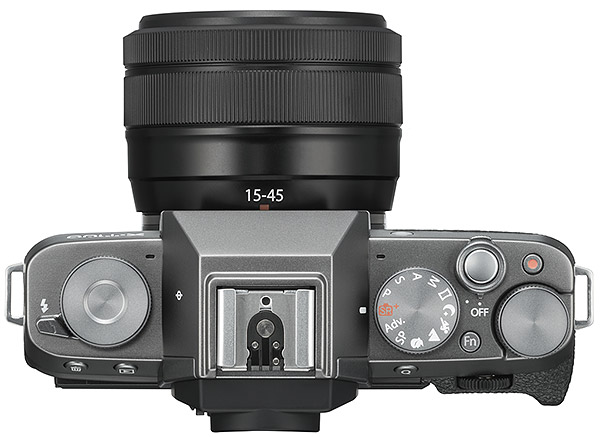
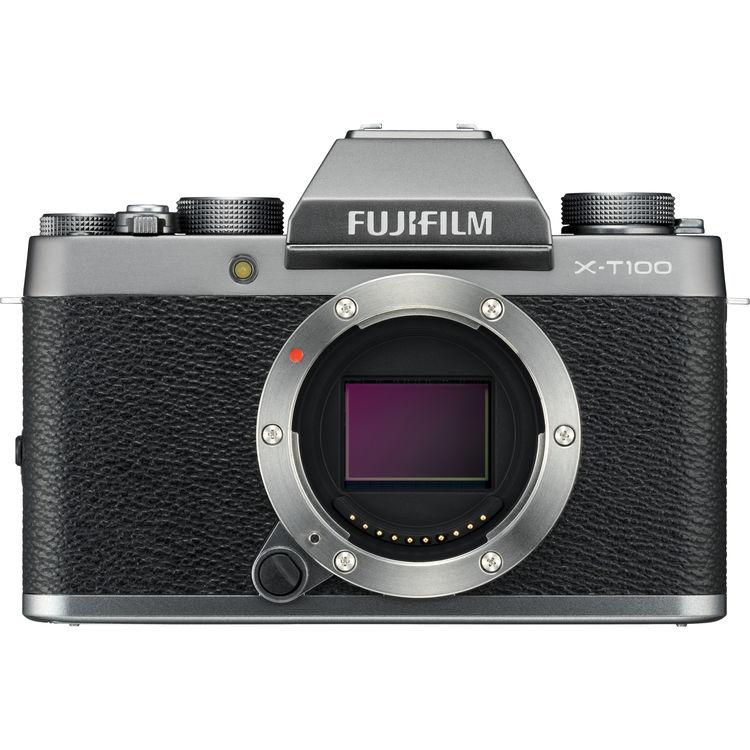
Yesterday, Fujifilm announced the new X-T100, an entry level interchangeable lens camera that offers a very similar
look and feel to the X-T20, but with slightly higher performance than the X-A5, and a consumer level price point- one that can match Nikon and Canon's budget models. There are a lot of reviews out there already, but I figured I'd give you my take.
With a stylish, SLR style design, a compact body, a 24.2 megapixel sensor, a 3-way tilt LCD screen wth
touch capability and Bluetooth connectivity, the X-100T has many of the regular X Series features, like the film simulations, Adv. Filter Modes, ISO speeds up to 12800, 6 fps shooting, Fn Buttons, Q Menu, video recording, 91-point Phase Detect autofocus, decent battery life, built-in flash, and full 14-bit RAW shooting. It even uses the same NP-126 style battery as the other Fujis.
What's Missing?
In order to bring the X-T100 in at only $599, they has to make some compromises. The main differences between this model and the higher end X Series cameras is that it has a regular CMOS sensor, not an X-Trans sensor, and it doesn't have the super fast X Processor Pro
chip.
This means it won't have the same AF speed and performance as the other models, it won't have the ACROS film sim and it won't have as big a buffer for shooting a lot of continuous frames.
However, that doesn't mean it's not a great
little camera. It still gives you excellent image quality with the Fuji colors and nearly all of the creative capabilities that you'll find on the other X Series cameras. In fact, many of the settings I cover in X SERIES
UNLIMITED are relevant to the X-T100.
It's pretty straightforward. The X-T100 is the ideal camera for someone who wants a Fuji camera, but doesn't want to spend $900. Starting at only $599, the X-T100 is a very attractive choice for someone who might otherwise turn to a beginner DSLR. This gets them in
the door shooting mirrorless and shooting Fuji.
It's also an excellent backup camera if you're already shooting one of the higher end models. It's quite small, so it's a great travel camera. And, of course, it will use any of the X Series lenses, so it could function nicely as a second body. Really, it's great for general photography, especially if you're not a
heavy action shooter or someone who abuses your cameras.
In the end, the X-T100 is just a sweet little inexpensive Fuji that comes in 3 colors: Black, dark silver and champagne gold. Just like an iPhone, only way better and way cooler.
Why Do You Share Your Photos Online? |
I just read an insightful blog post by California photographer Richard Wong, called Why Do You Share Your Photos? It’s a very concise piece, but for how short the article is, Richard asks an enormous question.
People have always shared their photographs, but with the immediacy of digital technology and the life-dominating, all-consuming propagation of social media, the notion of
“sharing” has taking on a while new life...
|
|
Read More
|
|
|
Dan Bailey
dan@danbaileyphoto.com
|
|
|
|
/cdn.vox-cdn.com/uploads/chorus_asset/file/11413481/X_T100_DarkSilver_BackObl.jpg)